Mayaguez Incident Still Haunts Marine
He had just helped overthrow the government of South Vietnam, essentially ending the mission that had deployed him some 8,000 miles from his home, but one last battle loomed on the horizon for the commander of Seminole’s American Legion Post.
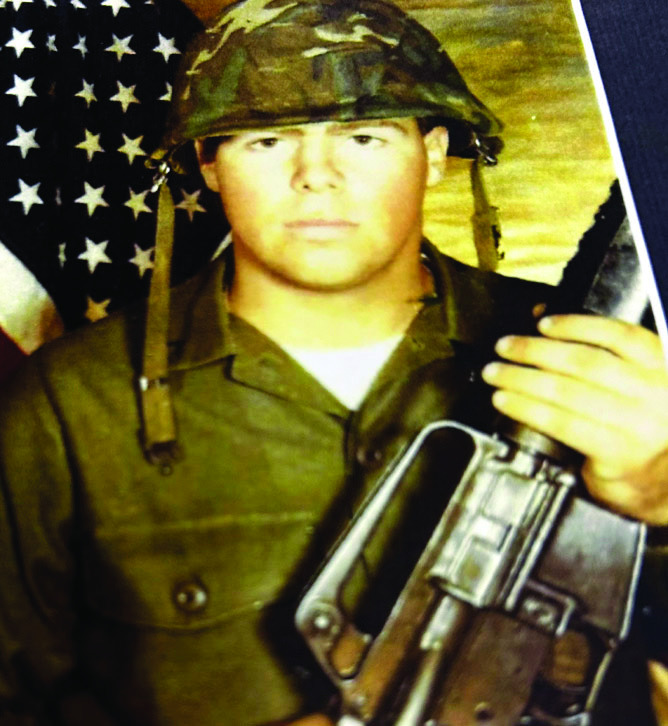
Carl Odom, a Lance Corporal in the United States Marines, was there for the Fall of Saigon on April 30, 1975. About two weeks later, he was about 35 miles off the coast of Cambodia when he and his fellow marines were given another assignment.
“We’d been back from Saigon about two weeks, then this merchant ship got captured on the 12th of May,” Odom said. “We were at Northern Training Area One in the monsoon, and they came and got us out of the field at about three in the morning. They took us back to base and told us to pack our C bags, put our wheels on top and stack them. We grabbed our weapons, our packs, our cartridge belt and helmets.”
Unbeknownst to him, Odom was about to take part in another historic event: The Mayaguez Incident, a 14-hour battle on Koh Tang Island to rescue the crew aboard the SS Mayaguez.
“My commanding officer and a couple of others went up in an airplane over the island (Koh Tang). That was the only intel we had of what the island looked like,” Odom recalled. “Later on, we were briefed and put in helicopter crews of 20. We were using the Jolly Greens, which aren’t supposed to have more than like 25 people total on them. They lined us up, our 20 guys, and then they started handing out ammo, hand grenades and stuff.”
Odom says they were told there would be only 20, maybe 30, “lightly armed” fishermen on the island.
“That was a joke,” Odom said. “Well, as we got close to the island, the first helicopter was shot down. Then the second helicopter got shot and crashed into the ocean. Our helicopter, a search and rescue craft, landed on the island, and when it dropped the ramp, we were off.”
As soon as Odom’s unit hit the ground, they began to take on enemy fire.
“There was a great big old boulder there. The 20 of us got behind it because we were getting shot at,” Odom said. “Then the helicopter took off, and it took tail damage and crashed into the ocean. Everyone on it was killed.”
For the next hour, Odom and company waited for reinforcements to show up.
“The twenty of us on the island were sitting there waiting on the second wave to come in. The palm trees and bushes were so thick you couldn’t see. But they [the enemy] were climbing the palm trees, laughing at us. So we just started shooting up in the trees,” Odom remembered.
No battle is without its casualties. Odom was shot in the shoulder, and his roommate was killed in an ambush.
“We captured an ammo bunker and about that time we heard that our battalion commander had landed. He landed at the wrong end of the island. This island is only like two miles long, about a mile at the widest. We were walking on the edge of the beach, and there was a cliff. Well, they’re dropping hand grenades on us and laughing at us. We picked them up and threw them back,” Odom said. “On the way back, we were ambushed. And we all kept telling everybody, ‘Keep your heads down!’ Well, my roommate stuck his head up and was killed.”
Odom said the body of his roommate was never recovered because they couldn’t take the dead with them when they left the island due to space limitations.
The mission was ultimately successful in rescuing the Mayaguez crew but resulted in the last U.S. combat casualties of the Vietnam War.
“We found out we went up against about 450 combat troops of the Khmer Rouge. There were 250 of us. And we only lost 41 to save a crew of 39,” Odom stated.
“The bones of 13 of them were recovered. We got permission from Arlington to put all 13 of the remains in a casket, and it’s buried in Arlington, and it’s got the 13 names on it. And the guy that led the troops against us was up for war crimes 50 years ago, because of the atrocities in the killing fields,” Odom concluded.
Three marines, Pvt. Danny Marshall, PFC Gary Hall and LCPL Joseph Hargrove, were listed as missing in action, but their deaths were ultimately confirmed.
Odom still carries the memory of the Mayaguez Incident with him, both figuratively and literally. The back of his leather vest is emblazoned with a commemorative patch of the battle.
“I’m going to put this vest down because it gets heavy after a few minutes,” Odom said during the interview for this story.
Carl Odom’s vest may be heavy, but the burden of losing friends and fellow warriors in battle may be just as heavy. Perhaps heavier than the vest.
“We went to a lot of funerals for these guys,” Odom said solemnly “It’s too much.”
More on the 50th anniversary of the Mayaguez Incident will be published next week in the Producer’s “Fifty Years Ago” column.