Man’s Appeal of 2014 Cleveland County Conviction Denied
The U.S. Court of Appeals for the Tenth Circuit denied an Oklahoma man’s challenge to his criminal convictions, rejecting his argument that the state lacked jurisdiction because he is a member of the Kickapoo Tribe of Oklahoma and that the crimes occurred on the Citizen Potawatomi Nation reservation.
Thomas Roye Wahpekeche argued that if the crimes occurred within a reservation, jurisdiction would belong to the federal government under the Major Crimes Act rather than the state.
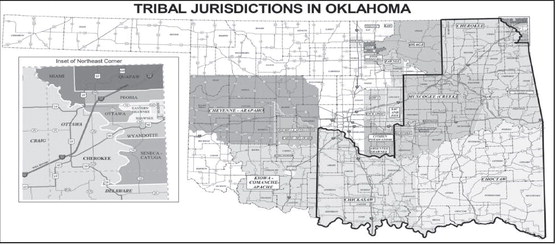
This case is one of many challenges following the U.S. Supreme Court’s 2020 decision in McGirt v. Oklahoma. In that ruling, the court held that several reservations in eastern Oklahoma were never disestablished by Congress, meaning certain crimes involving Native Americans must be prosecuted in federal or tribal courts rather than state courts.
The Oklahoma Court of Criminal Appeals has since recognized that nine tribal reservations remain in Oklahoma for purposes of criminal jurisdiction, including those of the Chickasaw Nation, Cherokee Nation, Choctaw Nation of Oklahoma, Seminole Nation of Oklahoma, Quapaw Nation, Ottawa Tribe of Oklahoma, Peoria Tribe of Indians of Oklahoma and Wyandotte Nation. The Court also determined that some historical reservations, including those of the Kiowa Tribe and the Osage Nation, were disestablished.
Wahpekeche was convicted of first-degree rape of a child younger than 14, forcible sodomy, lewd or indecent acts with a child younger than 16, rape by instrumentation and committing a lewd act in front of a minor.
After a Cleveland County District Court jury convicted him in 2015, Wahpekeche was sentenced to four life terms plus 108 years and is serving his sentence at the Joseph Harp Correctional Center in Lexington.
He appealed his conviction not only on the grounds that these crimes took place in Indian Country, but also alleging ineffective assistance of counsel, denial of due process and violations of federal law. The court rejected all of those claims.
The appeal also raised three additional jurisdiction arguments: that the crimes occurred in a dependent Indian community, that they occurred on allotted land and that the Oklahoma Enabling Act deprived the state court of jurisdiction.
Allotted land refers to parcels assigned to individual Native Americans under federal allotment policy, while a dependent Indian community refers to a Native settlement that is not formally a reservation but remains under federal supervision.
The court declined to address those arguments, finding Wahpekeche had failed to properly preserve them in earlier proceedings. The panel also said he did not explain how the Oklahoma Enabling Act would remove state jurisdiction.
Jurisdictional disputes between state and federal courts have become common since the McGirt decision. Another case awaiting potential review by the U.S. Supreme Court could address whether the ruling applies beyond criminal law.
In Stroble v. Oklahoma Tax Commission, a citizen of the Muscogee Nation argues that because she lives and works within the reservation boundaries recognized in McGirt, her income should be exempt from state taxation.
The Oklahoma Supreme Court ruled that McGirt addressed only criminal jurisdiction and did not extend to civil matters such as taxation. The case has been appealed to the U.S. Supreme Court, which has not yet decided whether it will hear the dispute.
Gaylord News is a reporting project of the University of Oklahoma Gaylord College of Journalism and Mass Communication. For more stories by Gaylord News go to GaylordNews.net.