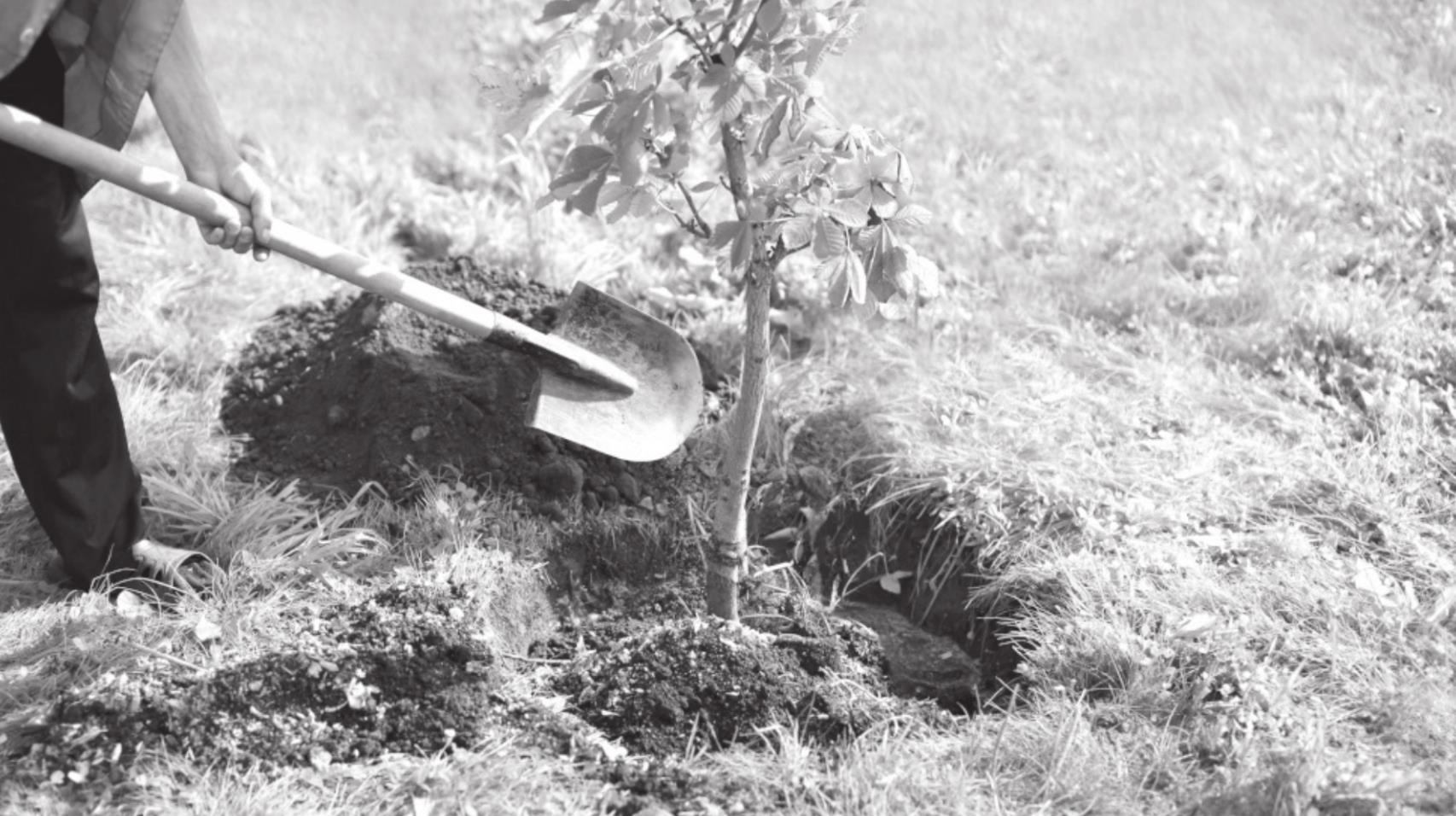
Techniques for Planting Trees
To ensure successful tree establishment, the following planting techniques and methods should be used.
When to Plant: The best time to plant most trees is spring or fall; however, many trees can be planted any time if handled properly. Plants installed during the growing season are susceptible to high transpiration rates leading to desiccation of plant tissues.
Early fall - best time for container - grown and balled & burlapped (B&B) trees.
Mid-February through mid-April - bare-root.
Handling Trees before Planting: Avoiding unnecessary damage and stress to trees prior to planting will ensure better success.
Keep root-ball moist.
Handle tree by the container, not by the trunk.
Preparing the Hole and Planting the Tree: Preparing the planting hole properly before planting is very critical. When working with heavy clay or sandy soils, organic matter such as composted manure, etc., can improve soil properties.
Add soil amendments to entire planting area prior to digging the hole. Do not apply amendments to backfill only.
Dig planting hole 2-3 times the diameter of tree’s rootball and no deeper than the root ball itself.
Plant trees at original grade OR plant trees 1-3” above grade if soil is poorly drained.
Do not put crushed stone or gravel in bottom of hole!
Remove all bags, containers, strings and wires. Burlap of B&B trees may be left on to decay but be sure to lay burlap back away from trunk and cover with soil. Synthetic burlap is used by some growers and should be removed.
If roots are excessive and circling inner walls of pot, shave about ¼ to ½ inch off all edges of root ball. Inspect for girdling roots and remove if possible.
Backfilling the Planting Hole: Fill in the planting hole (backfill) with native soil and tamp lightly. Soil amendments are not necessary and may result in further complications such as root rots.
Fertilizing: A new tree has a very limited capacity for utilizing fertilizer until it starts to establish itself. Do not overfertilize the new tree. If fertilizer is needed based on a soil test:
Incorporate fertilizer into entire bed area.
Do not dump fertilizer into bottom of planting hole.
Watering the New Tree: Apply at least one inch of water weekly during the growing season. Water should not stand longer than 20 minutes. In some soil types, surrounding soil may be moist while the rootball itself is dry. Be sure to occasionally check the rootball for adequate moisture.
Mulching the New Tree: New trees should be mulched using an organic mulch 1-2” deep; keep mulch at least 1-2” away from trunk of tree. Benefits of mulching to create a weed and turf-free area about 5-6’ in diameter include:
Reduced plant competition for water and nutrients.
Even soil temperature and moisture.
Pruning the New Tree: Avoid overpruning new trees. Leave lower limbs intact if possible. Remove injured or diseased branches only. Overpruning may result in sunscald and overall depressed growth.
Trunk Protective Materials: Protective wraps can provide physical protection against equipment, animals, insects, people, herbicides, etc. Protective wraps also provide protection by modifying temperatures and bark moisture for thin-barked trees such as ash, birch, linden, and maple.
If misused however, damage may occur in the form of trunk girdling or constriction, insects, diseases, and excessive moisture.
Protective wraps may not be necessary at planting time. Use based on type of protection needed.
Wrap loosely from base up to first branch by overlapping for shingle affect.
Do not use plastic twine.
Plastic guards should fit loosely and include holes or slits.
Plastic lasts longer and is quite resistant to rodents.
Inspect for damage and insects and spray for borers when necessary.
Staking Trees: Stake young trees sparingly and briefly when possible. Stake when top-heavy or planted in windswept areas. Always allow for sway. Too tight or prolonged staking results in an overall weaker tree. Remove stakes after one growing season or as soon as tree is sufficiently rooted.
Oklahoma State University, in compliance with Title VI and VII of the Civil Rights Act of 1964, Executive Order 11246 as amended, Title IX of the Education Amendments of 1972, Americans with Disabilities Act of 1990, and other federal laws and regulations, does not discriminate on the basis of race, color, national origin, gender, age, religion, disability, or status as a veteran in any of its policies, practices or procedures. This includes but is not limited to admissions, employment, financial aid, and educational services.