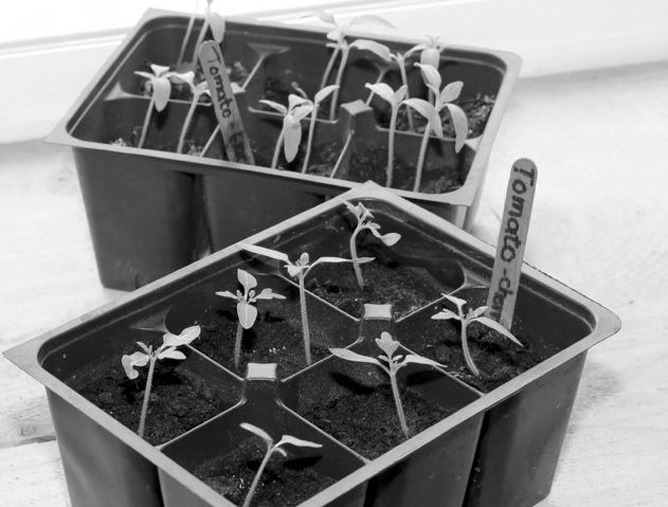
Starting Seeds Indoors Offers Many Benefits
Many gardeners choose to start their own seeds at home, rather than purchasing transplants. The advantages include savings in cost, and the availability of a much wider selection of cultivars. You can also time seed sowing according to your expected planting date so that transplants are ready when you need them. Of course, planting seeds and tending seedlings is also a great way to spend a winter day.
You can start seeds in flats purchased from a plant supply company or garden center, you can use expandable peat pots, or you can use a variety of household items. When selecting a container to start your seeds, consider drainage. You do not want water sitting in the bottom of the container. You also want to make sure the container holds enough media that it will not dry out too quickly and will have plenty of room for roots to develop.
The potting media you use is also important. Oftenyoucanfindamedia labeled specifically for seeding. Look for media with both good drainage and high water-holding capacity. These things seem contradictory, but you want your soil to hold adequate moisture for seeds to germinate without drying out too quickly, but you also want excess water to freely drain from the medium.
Light is often a limiting factor with starting seeds indoors. To produce hardy seedlings, you need 12 to 14 hours of light per day. Natural lighting is generally not enough. Supplement natural light using a shop light with alternating cooland warm-white fluorescent bulbs or specially made grow lights.
To plant the seeds, sow in rows 2 to 3 inches apart. Use a fairly tight spacing within the row.
As a rule, sow seeds to a depth of approximately 3 times the diameter of the seed. Most seeds will germinate well at a temperature around 70-degrees F held constant during day and night. After germination, temperatures can be lowered according to the type of plant you are growing. Refer to OCES Fact Sheet HLA6020 – Growing Vegetable Transplants for ideal growing temperatures.
For many tomatoes, a day temperature between 70- and 80-degrees F and a night temperature between 60- and 65-degrees F is ideal.
Managing water in seed trays can be tricky. Over-watering is a common problem. The seeds do not use much water until they have germinated, and seedlings are actively growing. However, the seeds need moisture to germinate. Misting the soil until it is thoroughly damp is a good way to provide moisture. Then, cover the seed tray loosely with plastic, checking soil moisture periodically. Remove the plastic once you see seedlings emerge.
Though fertilizer labels recommend weekly fertilizer applications, an application every two to three weeks is usually sufficient. The first application is not needed until seedlings are ready to be transplanted, two to three weeks after sowing.
For more info on starting seeds indoors contact your local OSU Extension office. Hughes county is in the courthouse and the number is 405-379-5470, while Seminole county is one mile west of Wewoka and their number is 405257-5433.
Oklahoma State University, in compliance with Title VI and VII of the Civil Rights Act of 1964, Executive Order 11246 as amended, Title IX of the Education Amendments of 1972, Americans with Disabilities Act of 1990, and other federal laws and regulations, does not discriminate on the basis of race, color, national origin, gender, age, religion, disability, or status as a veteran in any of its policies, practices or procedures. This includes but is not limited to admissions, employment, financial aid, and educational services.