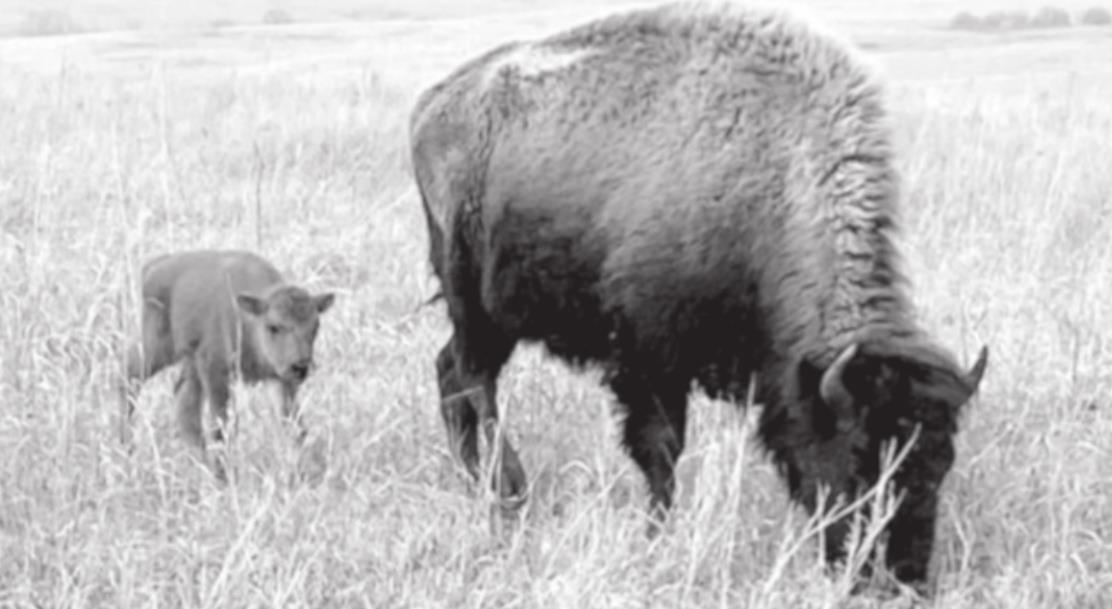
Say “Hello” to the First Baby Bison of 2021 at the Tallgrass Prairie Preserve!
Spring has sprung and bouncing baby bison can now be seen at the Joseph H. Williams Tallgrass Prairie Preserve in Pawhuska! The first bison calf of 2021 was seen yesterday morning being bashful and walking closely alongside its mother.
“This bundle of joy arrived a bit earlier than normal,” said Bob Hamilton, Tallgrass Prairie Preserve Director. “Typically, bison calves arrive around Easter weekend. Doing the math, that means this calf’s mom was bred in June–bison have a 9.5-month gestation period. We suspect that its early arrival is due to good forage conditions last summer which may have triggered early breeding. Additionally, minus the February cold spell, it was a pretty mild winter–so that may be a factor in its early arrival as well. Either way, we look forward to this exciting day each year!”
In the spring of 2020, 597 calves were born. Preserve staff expect another 500- 600 this spring making now a great time to visit the preserve to view the precious bundles of joy along with the 2,100 adult bison that roam freely. Young bison are fun to watch as they can be rather playful. Visitors may see calves frolicking, chasing, battling, butting, kicking, and racing. Such activity aids muscle development and coordination important later in life.
For the public’s safety, when visiting the bison, please observe the following rules:
Rule #1: Stay in your car!
Rule #2: Stay in your car!
Rule #3: Stay in your
car!
Bison are fast - they can go from 0 to oops (up to 35mph) faster than you can say it! If they’re blocking the road, be patient. Though they may be big and fuzzy, bison are wild animals and are not cuddly.
The preserve is open daily from dawn to dusk with no charge for admittance and can be accessed via county roads. There are free ranging bison herds, scenic turnouts, hiking trails, and picnic tables. The gift shop/ visitor center is currently closed.
Consisting of almost 40,000 acres near Pawhuska in Osage County, the Tallgrass Prairie Preserve is the largest protected remnant of tallgrass prairie left in the world! The Nature Conservancy of Oklahoma has proven successful at restoring this fully-functioning portion of the tallgrass prairie ecosystem with the use of free-roaming bison and prescribed fire that results in a constantly shifting landscape patch mosaic of native grassland habitats, supporting the full array of native prairie plants and wildlife. The preserve’s Christina Adams Bison Herd was established with a generous gift of 300 bison in 1993 from Kenneth and Diana Adams, Bartlesville, OK. Learn more by visiting nature.org/tallgrass.
Bison Facts
Though “buffalo” is commonly used, “bison” is the correct term for the mammals on the Tallgrass Prairie Preserve. According to scientists, true buffalo are confined to Africa and Southeast Asia.
Before the settlements of modern civilization, around 30 million bison roamed across North America. By 1890, fewer than 600 plains bison were left alive.
Bison are the largest native animals on the North American continent.
Full-grown bison bulls stand about 6.5 feet at the shoulder and can weigh up to 2,000 pounds.
Adult bison consume more than 30 pounds of grass (air-dry weight) in a day.
Bison can jump 6 feet vertically. Because they reportedly can jump more than 7 feet horizontally, “bisonguards” on the Preserve are 14 feet wide. (This is double the standard width of a cattleguard.)
Bison can run at speeds up to 35 miles per hour.
Bison are powerful swimmers, navigating with all but hump, muzzle, and top of the head submerged.
Both sexes have horns; the cow’s are smaller. A bull bison can be identified from a cow by wider, thicker horns; a wider skull; and a generally more massive structure.
The gestation period for bison is 9.5 months.
Bison calves are generally born in the spring and weigh 30-40 pounds.
The bison was named the state mammal of Oklahoma by the legislature in 1972.
About The Nature Conservancy of Oklahoma
The Nature Conservancy is a global, non-profit conservation organization that works to protect ecologically important lands and waters for nature and people. The Conservancy applies a systematic, science-based approach to species conservation, and pursues collaborative, market-based solutions to meet conservation challenges. The Conservancy and its more than one million members have effectively conserved over 15 million acres in the United States, and an additional 102 million acres worldwide. Since 1986, the Conservancy has worked to conserve more than 105,000 acres of Oklahoma’s magnificent landscapes and unique biodiversity. Learn more by visiting nature.org/oklahoma.