Protesters Storm US Capitol, Electoral College Debate Halted
He said the Constitution gives the states the responsibility for conducting elections.
“There’s a really important issue here, which is, does Congress have the constitutional authority and responsibility to sit in judgment of the various state-election processes?
And I think the very clear unambiguous answer is no, we do not,” Mr. Toomey said on WSBA radio Tuesday.
He criticized GOP colleagues who he said are suggesting that Congress should be in the position of deciding which states get to vote and which don’t in the Electoral College.
“First of all, that’s completely unconstitutional,” Mr. Toomey said, “but secondly, that would be the end of the Electoral College. I mean, let’s be clear: If Congress gets to decide which states vote and which ones don’t, that means Congress picks the president.
The American people don’t want Congress picking the president. They want to have an election in which they pick.”
Republican senators leading Wednesday’s challenges have shied away from saying that their intention is to keep Mr. Trump in office for another four years, even though Mr. Trump has made it clear that is his own goal.
“I have a very large number of people in my state that are saying, I know we can’t overturn an election, we shouldn’t overturn it. What can we do?,” said Sen. James Lankford (R., Okla.).
Mr. Lankford said he and the other GOP objectors in the Senate are trying to figure out the best way to address their constituents’ distrust in the election results in a way that is consistent with the Constitution.
“There really are millions of people around the country that really feel like something went sideways in this election,” he said.
“And their perception is there’s a whole group in the political class, in the media class that are telling them sit down and shut up.
They don’t like being told to sit down and shut up.”
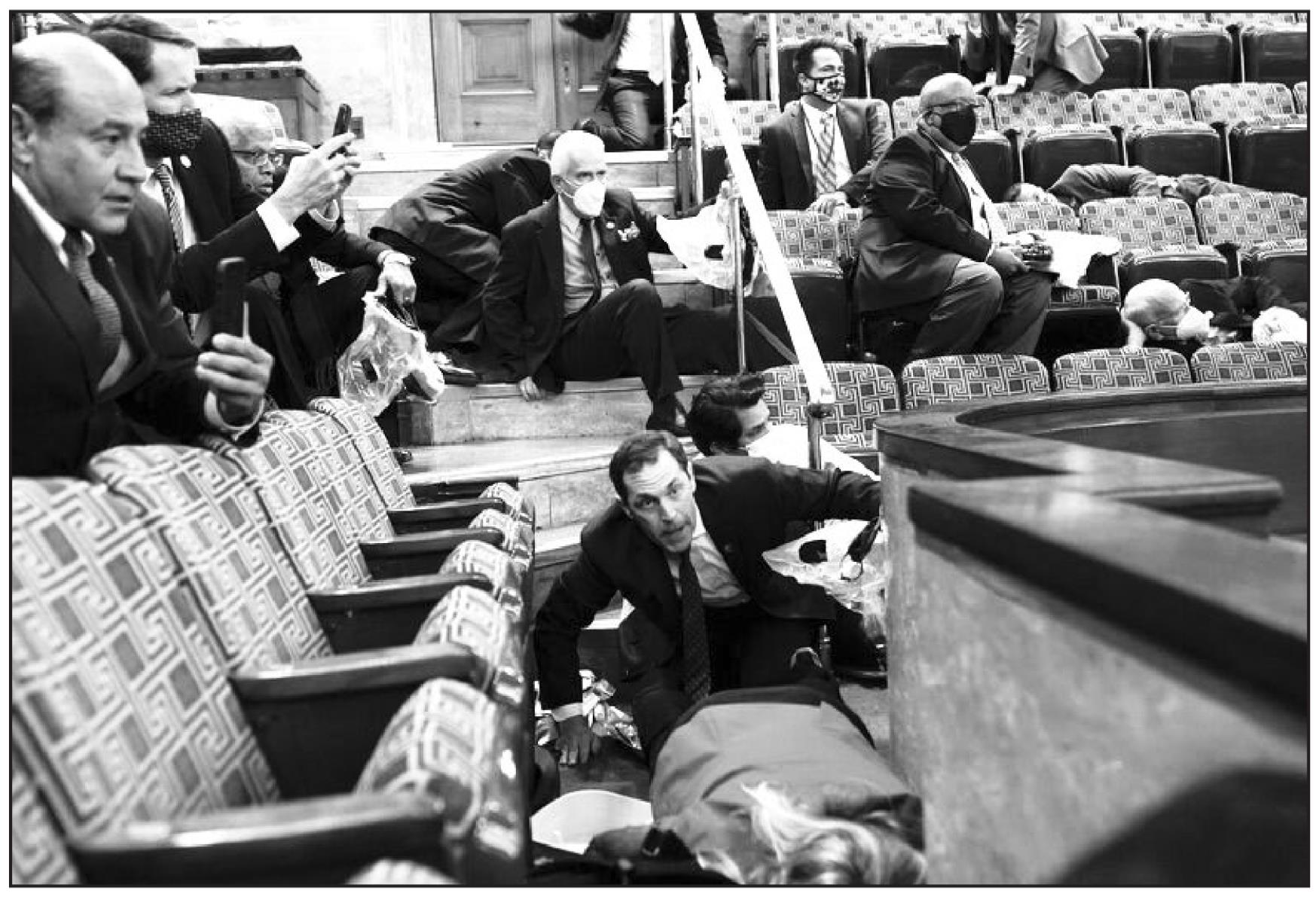
Supporters of President Trump stormed the Capitol complex in a chaotic scene, forcing lawmakers to shelter in place and halting debate over the ratification of President-elect Joe Biden’s Electoral College win.
Both the House and Senate chambers were gaveled out of session around 2 p.m. after protesters breached the Capitol.
Police sent an email message warning of a security threat on the West Front of the building, urging people inside to stay away from windows and doors. “If you are outside, seek cover.”
As Capitol Police rushed House leaders from the floor and people scrambled to close the chamber doors, Rep. Dean Phillips (D., Minn.) shouted at Republicans, “This is because of you!” Trump supporters could be seen walking the hallways just outside the locked doors carrying flags and yelling obscenities.
An officer in the House told panicked lawmakers they may need to duck under their chairs.
Rep. Steve Cohen (D., Tenn.) screamed, “Call Trump! Call your friend!”
Minutes later, reporters crouched on the floor of the press gallery reported hearing noises that sounded like gunfire.
Tear gas wafted through the Rotunda, and police handed out gas masks and began to evacuate lawmakers.
As they rushed away from the Senate, parliamentary staff grabbed hold of the boxes containing the electoral college certificates.
“There is nothing patriotic about what is occurring on Capitol Hill,” Florida Republican Sen. Marco Rubio tweeted. “This is 3rd world style anti-American anarchy.”
The unprecedented developments came on a day in which Republican allies of Mr. Trump challenged the election results from several states.
It was part of a last-ditch stand to keep him in office after two months of efforts to persuade state officials and courts to reverse his loss fell short.
They are turning to Congress to try to toss out several states’ electoral votes during a rare joint session Wednesday.
While testing the robustness of the Electoral College, the push has also exposed fault lines within the GOP and the broader polarization of the country.
“We will never give up, we will never concede,” Mr. Trump had told supporters gathered on the Ellipse near the White House around noon, as he implored Vice President Mike Pence and Republicans to work to overturn the election results and encouraged demonstrators to march to the Capitol.
“You don’t concede when there is theft involved.”
Mr. Pence said he doesn’t have authority to overturn the will of the voters, rejecting pressure from Mr. Trump.
“The presidency belongs to the American people, and to them alone,” Mr. Pence wrote.
“It is my considered judgement that my oath to support and defend the Constitution constrains me from claiming unilateral authority to determine which electoral votes should be counted and which should not.”
Before debate in the Senate was halted, Senate Majority Leader Mitch McConnell forcefully rebuked the president, saying “if this election were overturned by mere allegations from the losing side, our democracy would enter a death spiral.”
City officials had braced for potential violence in a repeat of unrest stemming from earlier pro-Trump gatherings.
As debate got under way on the House and Senate floors, a mob of protesters broke into the Cannon House Office Building, prompting police to order an internal evacuation. About an hour later, the chaos forced both chambers to recess.
“To those storming the Capitol—I am on the House floor and I will not be deterred from upholding my oath, under God, to the Constitution by mob demand,” Republican Rep. Chip Roy of Texas tweeted.
The 50 states and the District of Columbia certified their results last month. Usually the process of counting the electoral votes in Congress two weeks before the inauguration is little more than a perfunctory ceremony, lasting less than half an hour.
But on Wednesday scores of Republicans in the House and 13 in the Senate are expected to object to counting at least three states’ tallies: Arizona, Georgia and Pennsylvania.
Under an 1887 law, any such objection—as long as it is backed by one House member and one senator— triggers two hours of debate in each chamber.
Then lawmakers vote on whether to reject the Electoral College votes of the state in question.
It is virtually certain, however, that Wednesday’s challenges won’t succeed in either the Democratic-controlled House or the GOPrun Senate, where party leaders have opposed the effort and more Republicans say they won’t join in. Both chambers would have to agree to disqualify a state’s votes.
President Trump has blamed voter fraud for his defeat, but no significant evidence emerged that would challenge the result. Then-Attorney General William Barr said last month the Justice Department hadn’t found evidence of widespread voter fraud that could reverse Mr. Biden’s election victory.
Once the chambers broke up to debate an objection raised by a House and Senate lawmaker, Speaker Nancy Pelosi (D., Calif.) presided over the House, while Mr. Pence presided over the Senate.
“I think the gambit we’re seeing today is very disappointing,” Sen. Mitt Romney (R., Utah) told Capitol Hill reporters Wednesday. “President Trump has disrespected the American voters, has dishonored the election system and has disgraced the office of the presidency.
I’m confident we’ll proceed as the constitution demands and tell our supporters the truth, whether or not they want to hear it.”
For Sen. Chris Murphy (D., Conn.), Wednesday will be “a really heavy day,” he said in an interview.
“I’m not looking forward to it,” Mr. Murphy said, adding that Democratic lawmakers will be prepared to debunk any specific allegations of fraud raised by Republican objectors.
He said Democrats’ expectation is that a number of GOP senators will join them to counter the objectors’ arguments. He plans to speak in response to the second objection.
“This will be a pretty bipartisan rebuttal of these insurrectionists’ claims,” Mr. Murphy said.
Among the Republicans who plan to speak is Sen. Pat Toomey, who will defend the legitimacy of the electoral votes from his home