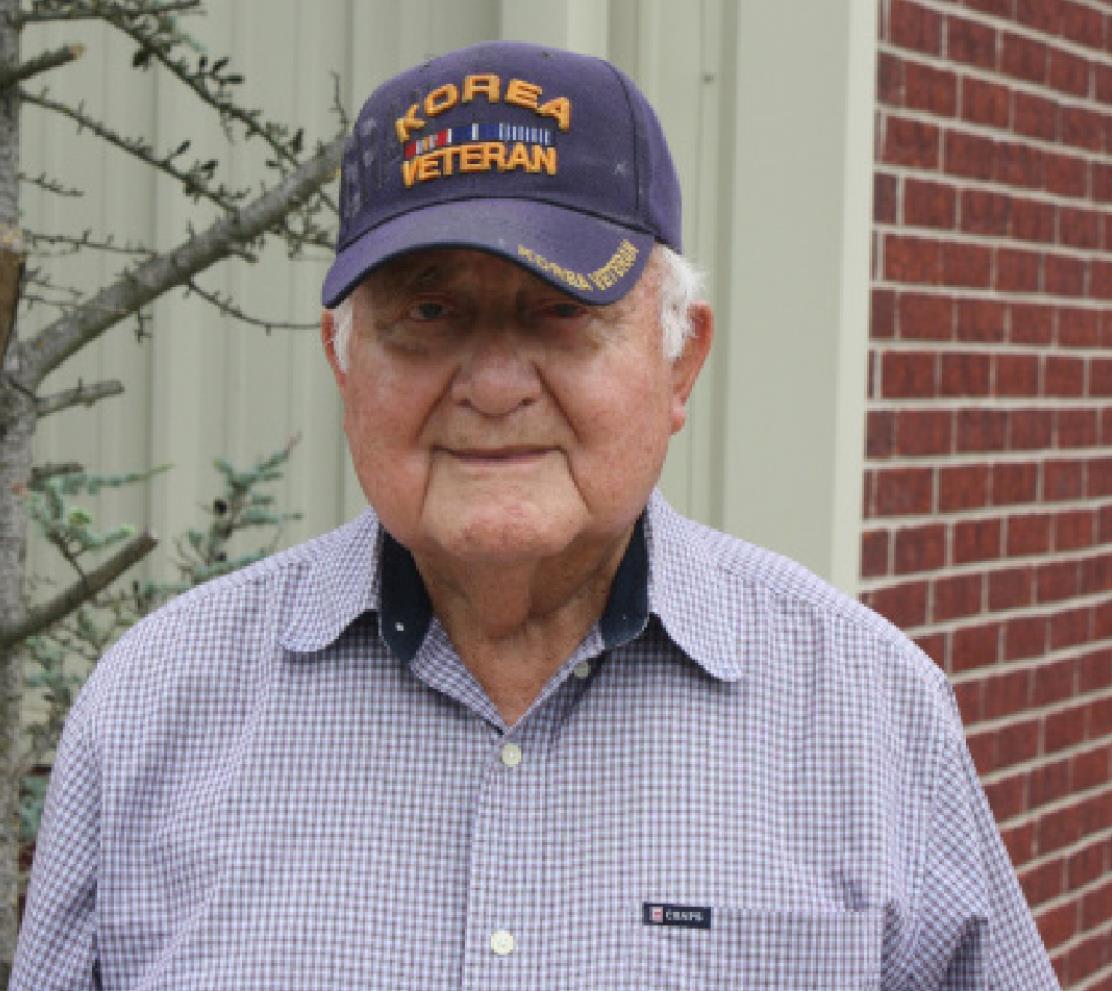
Life, Liberty and Love... One Centenarian’s Journey
It is fitting that on Memorial Day we remember those who served — and died — in military service to America. But for one local World War II veteran and centenarian, the celebration of a long life well lived is also in order.
When Shepherd Park Terrace’s Amos Charles (A.C.) Haston was born in Denison, Texas in 1914, the life expectancy for a male was 52 years. His early years among a family of farmers weren’t easy. Haston’s son William recounts that Haston bought his first pair of long pants with the proceeds of the sale of some cotton he grew on a small plot of the family farm.
In 1919, Haston saw his father Tilmon murdered and after, moved with his mother Mary to Wewoka, Oklahoma, where she found work as a domestic.
Haston said that education was a priority, and he proved that time and time again. He was his high school’s salutatorian in 1934, and an allstate halfback for the football team. At Langston University he played football, joined the Alpha Phi Alpha Fraternity and sang in a cappella choir, all the while working to pay for college.
He graduated in 1937 with a Bachelors of Science degree, in science and mathematics. Later, he did post graduate work at the University of Colorado and also received a Masters of Education in Secondary Administration from Texas Southern University.
His first teaching job was in a one-room schoolhouse, teaching first through eighth grade. A short time later he moved to a larger school in Hugo, Oklahoma where he taught math and coached football and basketball. It was a fortuitous move in more ways than one.
Doris Sampson arrived a few years later to teach Latin and music. She said the school’s principal met her at the railroad station and then drove her around: “It was summertime and hot. The windows were down. At the red light there was another car. I looked to my left and said ‘Who is that?’ The principal told me he was the coach and I would see him at the welcome party that night.”
See him again she did. “Every time I looked up, he was looking at me. Two weeks later we were dating.”
Pacific Theatre during World War II
The army came calling for Haston in 1941, but a heart murmur initially precluded him from serving. He married Doris on Christmas Day 1941. Summers, he worked for the railroad as a porter to make extra money and in 1942, Haston got Doris a pass to go to Portland for a delayed honeymoon trip. That’s when the army decided they did need him after all.
Haston served in the military almost four years. More than half that time was spent in combat, most notably in the U.S.’s invasion of the Philippine Islands.
‘When MacArthur said ‘I came through and I shall return’, we went in front of him,” said Haston. As a buck Private with an all-black unit in the 8th Army, he engaged Japanese forces in the jungles and mountains to which they had retreated.
He remembers Japanese snipers tied into the trees, who would draw American fire, thus sacrificing themselves but flushing out American soldiers. The kamikaze pilots also made a lasting impression “diving into the ships with their airplanes.”
Later, Haston rose to the rank as a Second Lieutenant in the Corps of Engineers. He applied for the Officer Candidate program with the Army Reserve but was put off by the segregation that existed with regard to the facilities. He left the military ready for a new chapter.
Houston comes calling
Haston resumed his teaching career in Ardmore, Oklahoma, and then became the principal of Lincoln High School in Nowata, Oklahoma. He and Doris had a son, William, today an attorney who works in the Legal Division of the Federal Deposit Insurance Corporation in Washington, D.C.
Because they wanted more opportunities for their son, the Hastons moved to Houston without jobs. It didn’t take them long to find one. Doris taught at Wesley Elementary. In 1959, Haston became a math teacher at Kashmere Gardens Junior and Senior High School. He taught Biology, Chemistry and Physics too. And in 1966, he became the school’s assistant principal.
Shepherd Park Terrace’s Joe Dennis had Haston for ninth grade science and said that “(he) was respected because he was firm but fair.”
The late 1960s brought a rapidly shifting cultural landscape. For the whole of their teaching life, the Hastons had both taught at all black schools. In 1954, Brown vs. Board of Education changed that — at least on paper. It took a while for Houston schools to follow suit.
‘We went in with confidence and things turned out very well,” said Doris, who like her husband has a masters from TSU. ‘We met resistance and we ignored it. It’s not about the color of your skin but the brains in your head.”
The secret to 100 years
Doris said her husband has lived so long because “he doesn’t worry about anything.”
A longtime member of St. James Episcopal Church where he served as a member of the Vestry and Sunday School Superintendent, Haston repeats the Serenity Prayer every day.
The one day at time concept took on special meaning in 1973 when Dr. Denton Cooley told Haston and Doris that Haston needed heart surgery on his Aortic valve. “He had a 50% chance of survival with the surgery and none without it,” said Doris. “There was a whole entourage following us around. Dr. Cooley kept telling them to ‘look at everything you see, because you will never see a case like this again.”
Haston has the Cooley-Cutter heart valve and is the longest living recipient of it. He lived to meet his two grandchildren and his great granddaughter. His last cardiologist told him to cut out the salt but Haston couldn’t quite bring himself to do that. Longevity might be in the genes. Haston says he has two aunts who lived to be more than 100.
He has stayed active in philanthropic endeavors as a member of Kiwanis International and a life member of Alpha Phi Alpha Fraternity. The fraternity’s Brother’s Keeper program which provides assistance to brothers, their spouses, and widows in need was renamed the A. Charles Haston Brother’s Keeper Program in 2010.
When Haston retired, the couple did a lot of travelling. Now their journeys are closer to home. They used to meet a group of friends at the Golden Corral every Friday, and still get out for special occasions. At a recent Kiwanis dinner and scholarship award ceremony, Haston was recognized for his recent milestone birthday.
When asked, Haston said he never thought he would live long enough to see the election of a black president. But he did. And whole lot more besides.