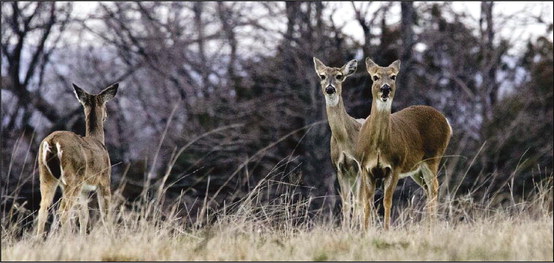
House Passes Bill to Strip CWD Management From Wildlife Dept.
A bill that strips the Oklahoma Department of Wildlife Conservation of its oversight of a deadly wildlife disease passed the House this week, with its author accusing the agency of taking a “mad scientist approach.”
It will be up to the Senate to decide if all future decisions about Chronic Wasting Disease, fatal to both wild and domestic deer and elk, should be left entirely to the Department of Agriculture, Food and Forestry.
Currently, the Wildlife Department oversees CWD efforts for free-ranging animals and Ag focuses on captive herds.
During Monday’s House floor discussion of HB 2862, Rep. Kevin Wallace R-Wellston was highly critical of the Wildlife Department and wildlife agencies generally. Early Thursday he summed it up in a comment emailed to the Oklahoma Ecology Project. “Wildlife agencies across this nation seem to have lost their way or have been infiltrated in recent years; there’s a difference between wildlife management, conservation, and extreme environmentalists,” he said.
CWD is an infectious brain disease specific to the family Cervidae, which includes deer and elk. It is one of a group of neurodegenerative diseases, including “Mad Cow” in cattle and Scrapie in goats and sheep. These are not viruses but are caused by misfolded proteins called prions. The resulting diseases cause brain cells to die. The time from infection to death can be 18 to 24 months, but animals are visibly ill only during the last two weeks of life.
CWD-free Oklahoma CWD has not been documented in Oklahoma’s free-ranging deer or elk populations but experts agree it likely is present because all surrounding states have documented cases. Four Canadian provinces and 29 states have logged positive cases in free-ranging herds as of 2022, according to the National Wildlife Health Center.
Animals in two domestic elk herds in Oklahoma, one in 1998 and one in 2019, died of CWD. In both cases, Agriculture Department personnel euthanized and tested all the animals and permanently closed the facilities.
The Wildlife Department annually tests dozens of wild deer killed by hunters, or as part of wildlife management plans, with more than 11,000 tested since 1999, according to department reports.
In response to a CWD-positive Texas deer found near the Oklahoma state line in 2022, Oklahoma hunters saw the first CWD “Selective Surveillance Area,” which covered a small portion of the Panhandle near Felt. Deer killed by hunters or found as road-kill in that area were tested for CWD. Restrictions required hunters to process their deer inside that zone and prevented the transport of certain carcass parts outside of the area.
The move followed one of the steps outlined in the state’s “CWD Response Plan” created in 2019, with help from outside experts, to define the respective roles of the Wildlife and Ag departments during CWD events.
Rep. Wallace airs concerns During Monday’s floor debate, Wallace charged that wildlife agencies have damaged both commercial and public hunting with an alarmist CWD approach. He said the state needs to do research instead of just killing deer and testing brain stems.
The reason for the bill is that current practices are “antiquated, inadequate, and not based in science,” he said.
Under the bill, the Ag Department would have all CWD oversight and create plans in consultation with “at least two” out-of-state experts.
Wallace made several points on the House floor Monday.
He cited a recent research paper and said CWD might very well be a “made-up” disease that is actually just Scrapie; he said Oklahomans should be outraged that the Wildlife Department killed roughly 100 white-tailed deer to test for CWD around the infected commercial elk farm in 2019; he said techniques exist that don’t require the killing of deer to be tested for CWD, and he downplayed the disease saying it is wildlife department and media hype that labels it always fatal and scares people into thinking it will wipe out wild populations.
He hypothesized that if a CWD-positive deer was introduced to a pen of healthy deer the infected animal would die but the majority of the others would not.
A national viewpoint “A lot of that simply isn’t true,” said Torin Miller, senior director of policy for the Georgia-based National Deer Association.
Biologists and veterinarians routinely share the same “CWD tools” and scientific knowledge nationally, he said.
“Many wildlife departments employ veterinarians and the approach is no different,” he said.
Miller said Rep. Wallace was inaccurate in some of his assessments of the disease. A study that involved directly inoculating deer with Scarpie prions of sheep and goats did show that deer are susceptible to Scrapie from sheep under some conditions and that determining the difference between Scrapie and CWD “may be difficult.”
“It is by no means a made-up disease or the same disease,” Miller said.
While live deer can be tested for CWD — typically using rectal tissue samples — the techniques if for captive herds and is much less accurate than brain-stem or lymph-node tissue tests that require that deer be killed, he said.
Testing tissues from hunter-harvested deer is the most common, accurate, and economical tool, he said.
‘Targeted removal’ controversial Thinning out CWD-endangered deer populations through liberal hunting seasons or landowner management plans is common practice, Miller said. When testing shows those measures have fallen short, “targeted removal” or “targeted culling” of a prescribed number of deer in a specific area–usually after the hunting season is closed–is the only option, he said.
It is also sometimes used, as in the 2019 case near the elk farm in Oklahoma, to rule out the presence of the disease based on the local population density and other factors, he said. It is a scientific sampling, not an elimination measure, he said.
Public education and prevention measures also have improved and taken a prominent seat in the management of the disease by wildlife departments in recent years.
“Targeted removal has always been a hot-button issue, and that’s among hunters and non-hunters alike,” he said.
He pointed to one documented example on the Illinois-Wisconsin state line. Wisconsin officials noted public pressure and stopped thinning the deer population. The CWD numbers soon spiked again in Wisconsin but not in Illinois, he said.
“The biggest problem with this bill is the (Wildlife Department) already has programs in place to take care of wild deer,” he said. “The (department) is best suited to engage with hunters, and a bill like this would take all that away from them and put it on the shoulders of the Ag Department, which if it is like most state agencies is already assuredly bogged down.”
Kelly Bostian is an independent writer working for the Oklahoma Ecology Project, a 501c3 non-profit dedicated to in-depth reporting about environmental issues for Oklahomans.