The House That Oklahoma Built
Oklahoma Ecology Project Out off a gravel road northeast of the town of Beggs, just past the point county services end, stands the kingdom Perry McDonald built–all thanks to a generally despised tree.
According to McDonald, if state legislators continue on a charge this session to eradicate the eastern redcedar — and only eradicate it — they are making a big mistake and overlooking the potential for jobs, business creation, and income for landowners.
“Education, that’s the thing we need to emphasize. People don’t know the value of redcedar. I built a kingdom with it,” he said.
The owner of Singing Wire Cedar sawmill illustrates his point with the story of a landowner who cleared land for grazing that included a few particularly large trees. The man kept the biggest trees and called on McDonald for a value estimate. The trees fetched several thousand dollars.
“He had some good trees and I gave him a good price, but you should have seen his face when I told him what we really should have talked about was the $150,000 worth he had pushed up in piles lining that long driveway coming up in there,” he said, shaking his head.
“He wanted to know what we could pull out of there and what it might be worth. I told him, ‘soon as you touched ’em with that bulldozer? — nothing’” Two bills introduced Native redcedar and the introduced tamarisk, both rapidly expanding invasive species, are the subjects of two bills filed this session.
SB 454, by Sen. Casey Murdock, R-Felt, calls for all state land management agencies to inventory the invasive trees on their lands and estimate costs for removal.
HB 2239, by Rep. Mike Dobrinski, R-Okeene, would set up additional funding mechanisms to help landowners, conservation districts, rural fire departments, and prescribed burn associations deal with tamarisk and redcedar. It would also create a pilot program on the North Canadian River for a watershed impact study tied to the invasive tree removals.
McDonald said the bills will fall short if they don’t encourage ways to monetize those removals, to build more businesses like his, or at least give landowners a way to help offset tree management costs.
Tamarisk is tough to remove and isn’t good for much more than mulch, but it is a good source for that, he said. Redcedar is another story.
“The demand for the cedar is incredible,” he said. “People just don’t realize what they have, and there is a lot of money to be had.”
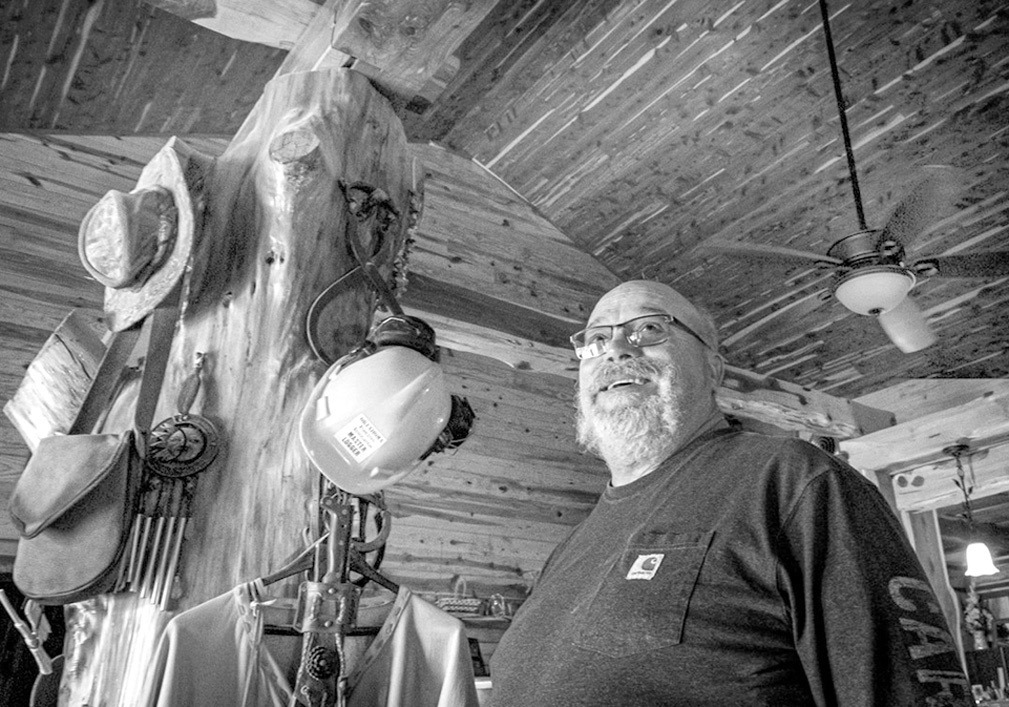
The house that Oklahoma built McDonald and his wife, Danette, call their 1873 square-foot lodge “In Your Backyard.” The outside and walls, most of the furniture and cabinetry — with the exception of a few boards here and there — are made entirely of native Oklahoma lumber.
“The reason we call this place In Your Backyard is because all of these trees grow in everybody’s backyard here in Oklahoma,” he said.
Rich with deep reds, yellows, and blacks, an 18-foot high cathedral ceiling that towers over the center living room and kitchen areas is covered in 1-by-6-inch redcedar tongue and groove.
In addition to redcedar, lighter woods like blued pine, hackberry, cottonwood, sycamore, and cypress, provide contrasts. Some walnut and red, white, and blackjack oaks, add different shades of dark brown and lighter hues.
None of it has seen an ounce of stain, just sanding seal and some lacquer, he said.
A talented carpenter, McDonald said this home that Oklahoma built is not something just anyone could build — or afford. He once worked up a bid for a similar treatment for a large home on Grand Lake and it came to about $1.5 million, he said.
“The guy said, ‘man! that’s a lot,’ and I just said, ‘well, yeah,’” McDonald said.
The couple lived frugally for the better part of 12 years and set aside lumber for their planned lodge for five of those years, he said.
Money to be had “I came down here in 2002 and carved out a kingdom and I’ve made a lot of money,” he said. “I started with three chainsaws and a tractor, a 1-ton truck and trailer and carved myself out a kingdom.”
At age 63 the U.S. Army veteran said redcedar has provided him with “plenty of money to live comfortably” and the couple can retire any time they want.
Anyone can still accomplish what he did, but they have to be ready for rugged, backbreaking work, he said.
“When that rooster crows and that light hits the door you better be pulling the string on that chainsaw because by 11 o’clock you’re already soakin’ damn wet and bleeding from three or four different cuts and everything else, but you can see what you’ve done,” he said. “You finish up by noon to be on your way home, take a two-hour nap, and then get up and unload your truck and get ready to do it again the next day.”
Education and legislation Talking politics isn’t new for McDonald but it’s been a lot of years. He makes it clear he is a common-sense conservative with little tolerance for party lines. His kind of plain talk is not always appreciated, he said.
Governor Brad Henry appointed McDonald to head the since-defunct Oklahoma Red Cedar Board in 2010. He didn’t quite finish out his 2-year term after Gov. Mary Fallin was elected and he ruffled feathers over some redcedar legislation introduced at the time.
The state hasn’t succeeded with past plans meant to encourage the harvest of the trees and he said the bill of that moment strayed from rewarding landowners to control the species voluntarily.
“Part of that made it so all these people from out of state had to do something with their cedar,” he said. “People go in and they cut down all their cedar and (the federal Natural Resources Conservation Service) gives them a little money and 20 years later I’m back in there cutting trees down again because they never followed up and burned it,” he said.
Kelly Bostian is an independent writer working for the Oklahoma Ecology Project, a 501c3 nonprofit dedicated to in-depth reporting about environmental issues for Oklahomans.