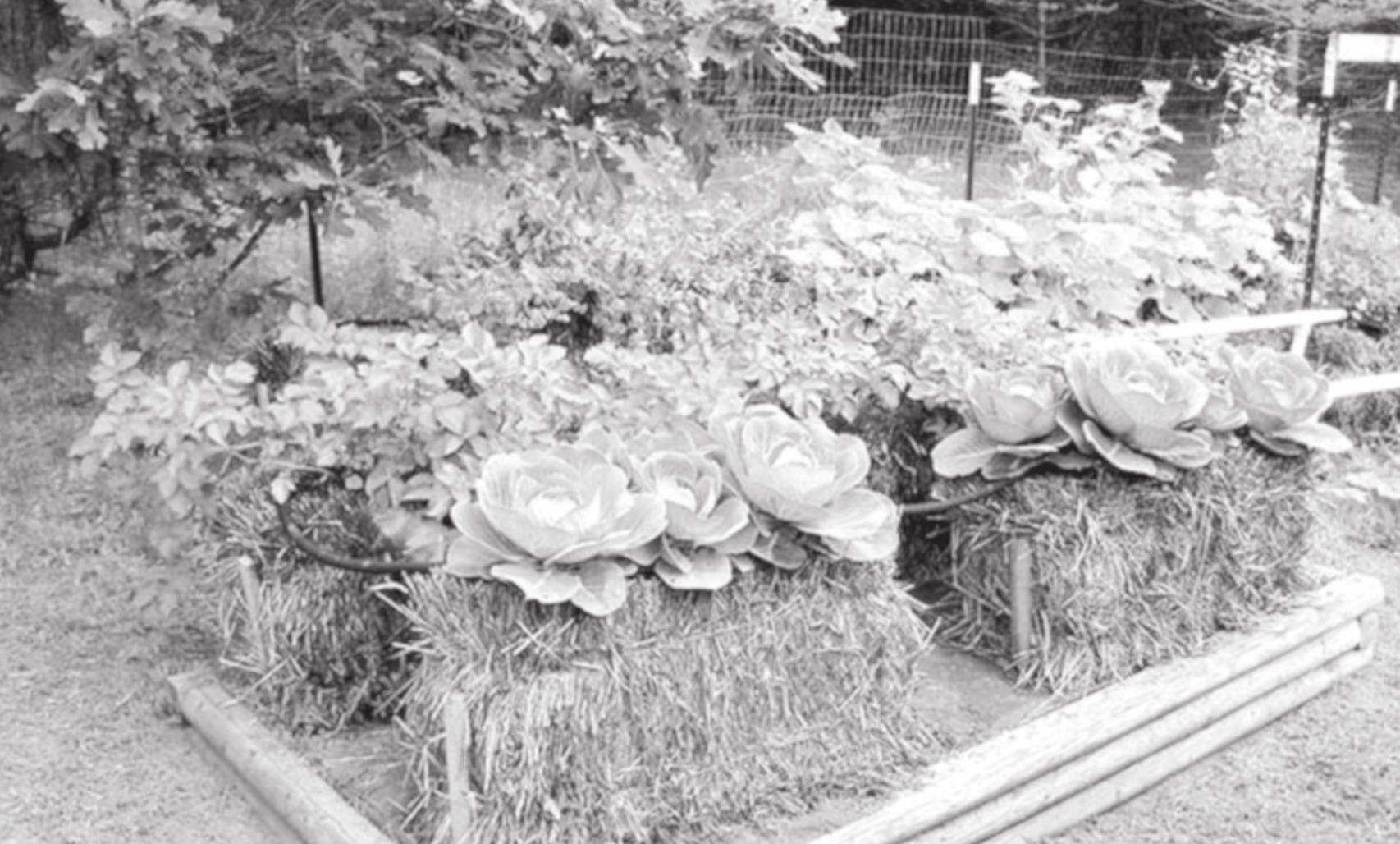
Have You Heard About Strawbale Gardening?
Do you have bad soil or perhaps you are in a temporary living arrangement and don’t want to invest in a raised bed, but still want to garden. If so, strawbale gardening maybe the solution. Typically, strawbales are preferred over hay bales, due to the number of weed seeds, but both still have some seeds in them.
Place the bales so the wire or twine is parallel to the ground. Do not unwrap the bales. The wire or twine is keeping the raised straw bed held together. The sides that don’t have the twine is the top and bottom.
If using a new bale, it will need to be conditioned or aged before planting. This process will typically take about two weeks. Conditioning a bale means initiating decomposition within the bale. This is important to do before planting, otherwise, microbes will take available nutrients away from the plants.
To condition a strawbale, water it every day and sprinkle a nitrogen rich fertilizer on top of it every other day for 14 days. During the 14 days, the bale will heat up. This this is an exothermic reaction. You may notice the temperature change by sticking your hand down into the bale or using a compost thermometer. Another way to see if the bale is heating up is to get a piece of rebar or some metal rod and stick it into the bale. Let the rebar set for a minute then remove it and carefully touch it to see if feels warm. This will allow you to gauge what is going on inside your bale. After a noticeable temperature spike, the bale will cool down again. This temperature spike and cool down typically occurs in a 14-day window. After this, the strawbale is conditioned and ready to plant.
There are two ways to plant a strawbale garden. If the bales are all lined up, a flat method can be used by putting 2-3 inches of compost along the entire top of the bale. The pocket method can also be used by spreading the straw apart and creating pockets. Fill the pockets with compost. The size of the bale and the plants being used, will determine how many pockets can be made.
For about $5 a bale, a raised bed can be constructed. Plus, an added bonus, at the end of the growing season the straw can be added to the compost pile, to another area of the garden as a mulch layer, or for walkways between next year’s strawbale garden. Each year of strawbale gardening will only improve the soil under your feet.
For more information about strawbale gardening, check out fact sheet PSS-2264 - Straw Bale Bed: A Way to Garden While Building Soil. Or as always call your local OSU extension office, in Wewoka the number is 405-257-5433 or to reach the office in Holdenville, 405-379-5470
Oklahoma State University, in compliance with Title VI and VII of the Civil Rights Act of 1964, Executive Order 11246 as amended, and Title IX of the Education Amendments of 1972 (Higher Education Act), the Americans with Disabilities Act of 1990, and other federal and state laws and regulations, does not discriminate on the basis of race, color, national origin, genetic information, sex, age, sexual orientation, gender identity, religion, disability, or status as a veteran, in any of its policies, practices or procedures.
This provision includes, but is not limited to admissions, employment, financial aid, and educational services. The Director of Equal Opportunity, 408 Whitehurst, OSU, Stillwater, OK 74078-1035; Phone 405-744-5371; email: eeo@okstate.edu has been designated to handle inquiries regarding non-discrimination policies: Any person (student, faculty, or staff) who believes that discriminatory practices have been engaged in based on gender may discuss his or her concerns and file informal or formal complaints of possible violations of Title IX with OSU’s Title IX Coordinator 405-744-9154.