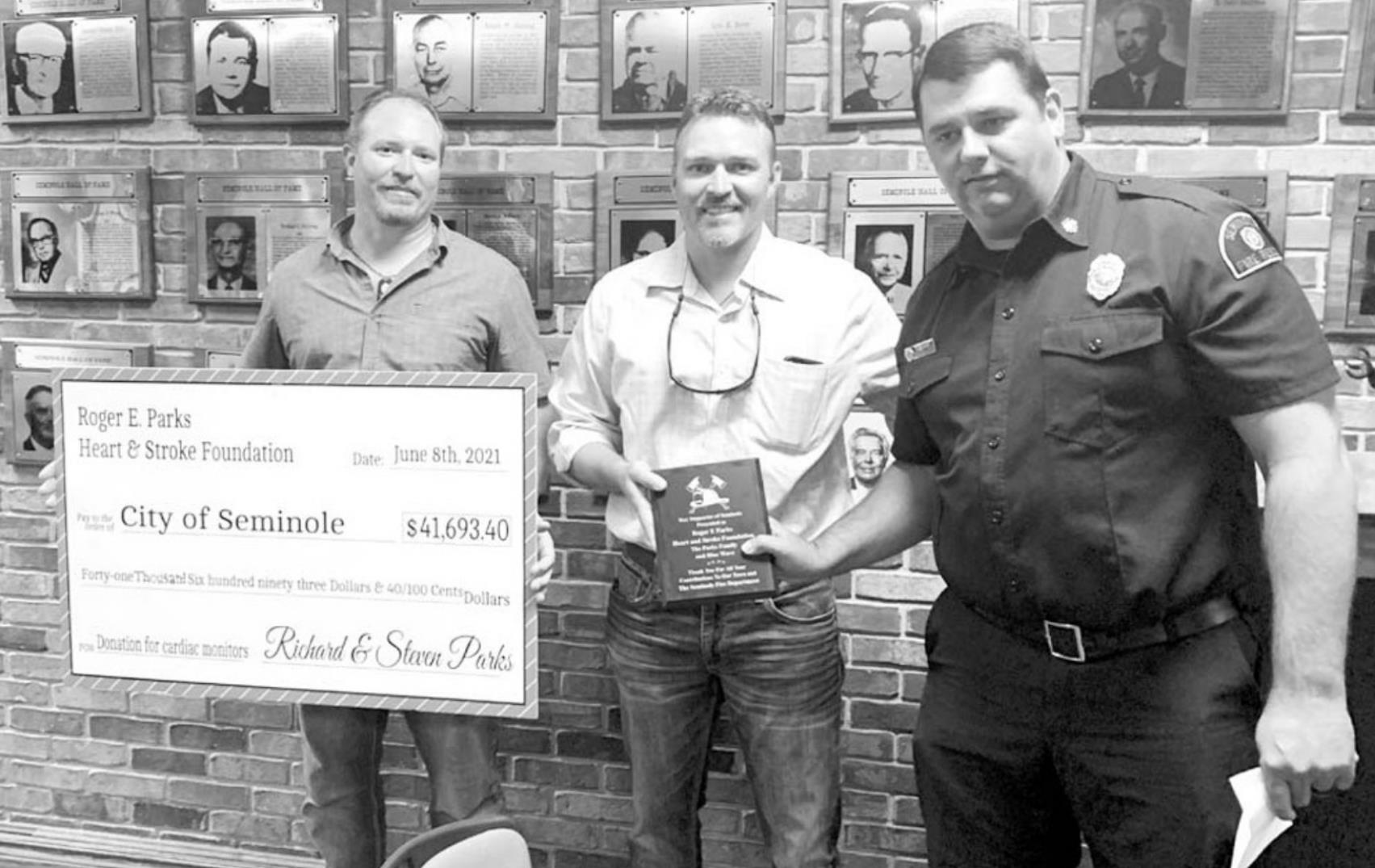
Foundation Makes Life-saving Donation to City of Seminole
Ever since Roger E. Parks passed away in 2018, his sons, Richard and Steven, have been trying to find a way to honor him and help the community of Seminole at the same time.
The family started the Roger E. Parks Heart and Stroke Foundation in 2018 and have since helped various organizations and students, and has even sponsoring line dancing at the Seminole Municipal building in support of advancing heart attack and stroke research.
When a need for cardiac heart monitors was brought to the Foundation’s attention by Seminole Fire Chief Fielding Lucas, Richard and Steven knew that purchasing the life-saving devices would be a great way to honor their father.
At Tuesday’s regular meeting of the Seminole City Council, the foundation donated $41,693.40 to the city to purchase two cardiac heart monitors that will be installed in two ambulances.
According to Lucas, the LIFEPAK 15 Defibrillator/Monitor is “without a doubt” the most rugged and reliable defibrillator on the market today. The machine combines the finest in defibrillation technology with an incredibly tough design capable of withstanding the harshest of environments and scenarios. The equipment can withstand at least a 30-inch drop and operate without fail in a downpour and hurricane-like winds.
The LIFEPAK 15 features Physio-Control's ADAPTIV biphasic technology capable of delivering therapy of up to 360 Joules. It is also the first defibrillator to integrate non-invasive monitoring of carbon monoxide, SpO2, and methemoglobin (which detects certain drugs and chemical exposures). Other features include external pacing, temperature monitoring 360J energy and 12-lead ECG transmission with Bluetooth Technology.
The 15 continuously monitors all 12 leads in the background and alerts personnel to changes using the ST-Segment trend monitoring feature, after acquiring the initial 12-lead. The 15 also works seamlessly with the LIFENET, so critical patient data can be shared with multiple patient care teams.
“That means if you call the Seminole Fire Department for chest pain and we take a 12 lead of your heart and see that you are having an acute myocardial infarction we can transmit the 12 lead to a doctor,” Fielding said.
“The 12 lead is the key diagnostic tool to determine eligibility for acute reperfusion interventions. The contribution of early intervention by paramedics trained in critical care is potentially considerable, particularly in the important chain of survival that is often initiated by pre-hospital intervention,” Lucas added. “This reduces morbidity and mortality rates. SFD ambulance services can play a role in minimizing time to treatment for patients with AMI.”