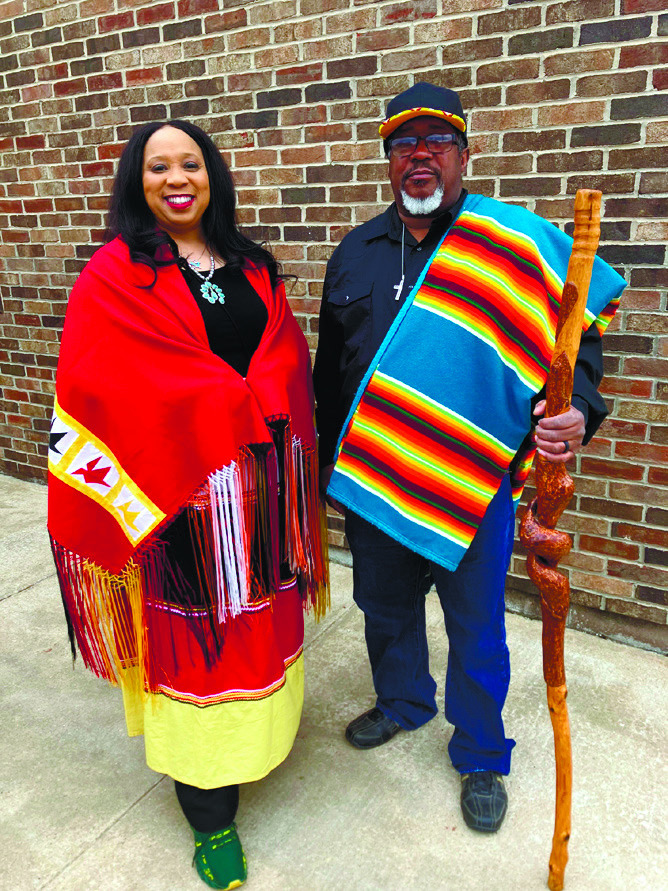
Dosar Barkus Band Seeks to Educate About Black Seminoles
The Dosar Barkus Band (Estelusti Freedman) and Seminole members of other bands in the Seminole Nation of Oklahoma seek to educate and celebrate the contributions of Black Seminoles during the month of February. Oklahoma is home to black Indians who lived in Indian Territory.
“There are many Seminoles who do not know that we celebrate the contributions of the Freedman Bands annually in February and all year round,” said Reginald Knighton, Dosar Barkus Band Chief of the Seminole Nation of Oklahoma. “We are proud of our untold history of warriors, which stems from the Florida Seminoles, who fought alongside of Black Seminoles during the Seminole Wars.”
Recently, Black Seminoles attended the 25th Anniversary Seminole Maroon Family Reunion in honor of the 185th Anniversary of the two Battles of Loxahatchee River. The Celebration took place in Juniper, Florida. It was hosted by Dr. Wallis Hamm Tinnie, of the Florida Black Historical Research Project, Inc., in the “Telling the Full History,” weeklong program in Palm Beach County. The theme was Revisiting the Past, Assessing the Present, and Shaping the Future of the Seminole Diaspora and Beyond, as they honored the legacy of Dr. Martin Luther King, Jr.
The goal is to educate Black Seminoles to know their history from Abraham to the Indian removal, the Trail of Tears to Seminole Warriors John Horse and Wildcat, and to all our relatives from Florida, Oklahoma, Mexico, Texas, and the Bahamas, including the Seminole Indian Scouts. Monthly band meetings are held to help new members with tribal enrollment, access health care services, preserve our history, language, and expand our housing, education, and social service programs. Information is provided for tribal elections and voting benefits, and annual activities.
“I believe that both Red Seminoles and Black Seminoles need to be educated on our history and the contributions from our communities,” said Phillip L. Barkus, Assistant Band Chief of the Dosar Barkus Band. “I often ask the question. Have you read the 1866 Treaty, Article 2? The answer is always no. This should be a starting point. This treaty was signed Mar. 21, 1866. Ratified, July 19, 1866, by Congress and Proclaimed Aug. 16, 1866, by the president of the United States.”
An excerpt of the 1866 Treaty ARTICLE 2. The Seminole Nation covenant that henceforth in said nation slavery shall not exist, nor involuntary servitude, except for and in punishment of crime, whereof the offending party shall first have been duly convicted in accordance with law, applicable to all the members of said nation. And inasmuch as there are among the Seminoles many persons of African descent and blood, who have no interest or property in the soil, and no recognized civil rights it is stipulated that hereafter these persons and their descendants, and such other of the same race as shall be permitted by said nation to settle there, shall have and enjoy all the rights of native citizens, and the laws of said nation shall be equally binding upon all persons of whatever race or color, who may be adopted as citizens or members of said tribe.
The history of Freedman Bands was featured in the Seminole Nation Museum in the town of Wewoka, during the month of February, 2022. The National Seminole/Gullah Artist, Johnny Montgomery was also featured last year with an outstanding Art collection of Black Seminoles.
“We are also delighted to have a great partnership with the First Americans Museum (FAM) in Oklahoma City,” more specifically in House District 99,” said former Representative and Senator Anastasia A. Pittman, a Seminole Legislative Council Representative. “We collaborated on the $90 million dollar concept and vision of former Seminole Principal Chief E. Kelly Haney, a former State Senator. We passed the bill to help fund the project after a decade of work with legislators, and the Oklahoma Indian Commission to build the American Indian Education and Cultural Center. It is now worth over $200 million, and we are not done yet. This year the FAM celebrated Afro-Indigenous, Black Natives, and Indigenous People of Color with a photo shoot, to capture a few members of Oklahoma’s diverse populations, and we are grateful for progress.” Pittman said.
There are flat brick markers that represent all 14 bands of the Seminole Nation of Oklahoma located at the left side of south steps of the State Capitol initiated by Chief Enock Kelly Haney, who is also the Master Artist of the 22-foot statute of the Guardian on the Capitol Dome.
“We are history makers in the Seminole Nation of Oklahoma. I am proud to be the third generation Seminole elected to the state legislature,” said Representative Ajay Pittman, Vice Chair of Tourism and Co-chair of the Oklahoma Native American Caucus. “It is an honor to represent my native heritage on a national level, as the secretary of the National Caucus of Native American State Legislators. This organization was founded by Senator Kelly Haney in 2004. My native great-grandmother was a vital part of our native language, food, and culture. Now, I serve in her honor and as the first female legacy legislator to serve in my mother’s House District 99 seat.”
Dosar Barkus Band Members are celebrating with the Cesar Bruner Band members not only in February, but in June for Red Earth, the 3rd Saturday in September for Annual Seminole Days, October for Indigenous Peoples’ Day, and in November for National Native American Heritage Month, as we honor our Veterans.
“I am proud of our joint efforts to bring hope for the future to the Seminole Nation. We are one people who will become stronger, when we strive to unite and serve all members,” said LeEtta Osborne Sampson, Cesar Bruner Band Chief and Seminole Legislative Council Representative.