
latest
After months of hard work and thoughtful negotiation, I’m proud to share that we’ve reached a responsible and forward-looking budget agreement that delivers real relief to Oklahoma families.
Read moreThroughout this series of articles, there has been an underlying and heretofore unexplored question: Did the apostles make the whole thing up? Was the claim of Jesus’s resurrection from the dead some grand hoax, some grand myth that quickly grew into a phenomenon placing the disciples in the grand spotlight of Christian stardom? After all, an empty tomb could have simply meant that the disciples (or anyone else, for that matter) stole the body. However, since the traditional Christian answer to this question has much merit, it bears further explanation here. Historian Craig Keener has said that the “ancients also recognized the willingness of people to die for their convictions, verified at least the sincerity of their motives, arguing against fabrication.” Others have made similar statements claiming that people have often died for a lie they thought to be the truth, but no one ever dies for what they know to be a lie. As far as the apostles were concerned, Jesus, in a resurrected corporeal body, appeared, spoke, moved about, and ate food. These appearances of Jesus moved the disciples so much that they would later die for that belief. At any rate, the critics ask, “Is that true?” The answer is incredibly important. Not because the apostle’s martyrdom alone means that Jesus was raised from the dead, but because if the apostles willingly died for their faith, convinced that a risen Jesus had appeared to them, the same One who rose and left the tomb empty, the One about whom four eyewitness accounts were later written, the One about whom almost immediately the oral Credo began to be recited, that One, then, the cumulative evidential weight of the resurrection narrative, and the case for Christ deserve a long hard look. So, did the apostles die for their faith as Christian “legend” suggests? Since this series of articles has primarily focused on Peter and Paul, we will look at the historical evidence concerning their alleged martyrdom. First, however, the most recent and perhaps the most exhaustive modern historical examination of the fate of the apostles is that of Sean McDowell in his book, The Fate of the Apostles. McDowell suggests all told, there are at least ten independent sources, both canonical and non-canonical, that give us a very good idea of what happened to Peter. Based upon these sources, all written within the living memory of Peter up until c. AD 200, we can make the following conclusions. First, the traditional view that Peter was martyred for his faith is strongly attested, and no competing theories exist. Second, based upon the early historical evidence, the traditional view that Peter was martyred for his faith is given the highest possible probability, indicating that it is historically very probably true that Peter was martyred in Rome. Similar to Peter, Paul’s martyrdom is attested to by at least eight independent sources, both canonical and non-canonical, written within Paul’s living memory. AD 200. The traditional view of Paul’s martyrdom is that Paul was beheaded in Rome sometime between AD 64-67, during the reign of Nero. Detailed analysis of these independent sources indicates that historically, it is the highest possible probability that Paul was martyred in Rome, more probable than not by beheading. The historical fact that both Peter and Paul were martyred for their faith speaks to their unwavering commitment to what they considered to be absolutely true: that the risen Jesus had appeared to them, and they died for that belief. However, Peter and Paul were not alone. Apostolic suffering was universal. In fact, McDowell’s research suggests that there is strong historical evidence that at least six of the apostles were more likely than not martyred for their faith and that these events are historically true is considered the highest possible probability.
Read moreThe Boomer Seminole Duplicate Bridge group met Tuesday, May 13th. There were two and one-half tables in play. The winners were: First Place-Gayle Stacy and Justine Thompson, Shawnee.
Read more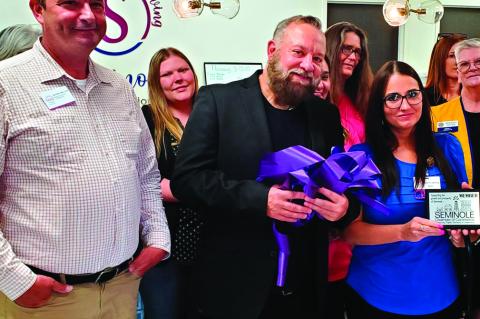
Attorney General Gentner Drummond is encouraging Oklahomans to take precautions to guard against elder fraud in recognition of National Senior Fraud Awareness Day today.
Read moreOklahoma CareerTech’s technology center campuses increased by one Thursday, when the State Board of Career and Technology Education approved a new campus for Gordon Cooper Technology Center.
Read more
Konawa High School Senior Will Neurauter has officially signed with East Central University’s Esports program, becoming the first student recruited directly to ECU through its expanding competitive gaming initiative. This milestone marks a significant step forward for both schools and highlights the growing role of Esports in educational pathways.
Read more
SSC Talent Search Students Attend Musical ‘& Juliet’
Read more