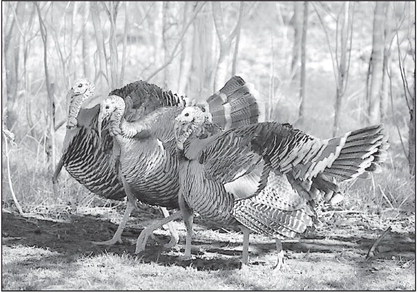
Wild Turkey Hunting Season Has Begun in Oklahoma
ODWC - Youth Spring Turkey Season arrived last weekend (April 11-12) across all of Oklahoma. Hunters 17 and younger had the first chance to harvest a gobbler during these two days ahead of the regular spring turkey season, which will run from April 16 to May 16 statewide. Bag limit is one tom turkey.
Based on the latest reports from the field, many areas are seeing more birds on the landscape than in recent years. But extremely dry conditions in the west seem to have held bird numbers steady in many of those areas.
The Oklahoma Department of Wildlife Conservation is wrapping up a 4.5-year, $2 million research effort with Oklahoma State University to investigate wild turkey populations in southwestern and southeastern Oklahoma. Researchers are examining nesting success, nesting site characteristics and cause-specific mortality of poults and hens, along with genetic health studies.
Wild turkey research continues in western Oklahoma with live trapping and data collection. At the end of February, 67 turkeys with GPS transmitters were being tracked, and 20 additional birds had been tagged with leg bands. The western team recorded six turkey mortalities during February, all resulting from predation.
In southeastern Oklahoma, researchers have tied GPS locations to nesting data and collected land cover information to learn about hens’ selection of tree cover throughout the reproduction phases of pre-laying, laying and incubation.
Hunters wanting to support researchers studies, along with ODWC’s conservation and management efforts, can simply purchase a hunting license, whether they intend to hunt or not. Each hunting license sold secures federal matching funds at a rate many times the price of the license, giving ODWC more resources to fund wildlife conservation activities.
Meanwhile, for hunters who are hoping to harvest a tom turkey this year, several ODWC biologists in the field have shared reports from their regions in this year’s Gobbler Report.
CENTRAL REGION
Report by Jay Rouk, Wildlife Senior Biologist
Current gobbler activity: Record warm temperatures have turkey flocks well established into breeding groups. Gobblers can be heard gobbling from the roost and, on calm days, into mid-morning. Gobblers are strutting in their lekking zones in the mornings until the temps warm up. Hens have been reported moving in patterns that would indicate they are establishing nest sites.
Condition of habitat: The warmer temps have promoted the rapid advance of spring plants. Many trees have already leafed out, and most fields are green with both cool and warm season grasses. Most wheat fields are lush but are on the verge of becoming too tall to be useful to turkeys.
Reports from landowners or scouting hunters: Turkey numbers seem to have increased this year by a slight margin. Toms have been heard gobbling in roost areas. Reports have lately increased of turkeys crossing the road or sighted out in fields.
WMA best bets: Kaw WMA, near the Kansas border, has considerable ag production which usually
attracts a fair number of turkeys. Deep Fork WMA has a useful blend of uplands and remote river bottoms which can be rewarding to those willing to explore the area. The area is within reasonable driving distance of both Tulsa and Oklahoma City. Hickory Creek WMA is traditionally a good choice for south-central hunters.
Tips for success: 1.
Scout ahead of time to learn the daily patterns of the turkeys in your hunting area. Position yourself so that your calls are persuading them to move in a direction they commonly travel. It helps to know of, and avoid, obstacles between you and the turkeys.
2 . Many gobblers are too preoccupied with hens in the early morning to respond to calls. However, once hens move to nesting activities, gobblers are easier to call. This tactic works especially well in the late morning before it gets too hot.
3. The warm temperatures have promoted the emergence of ticks. Take necessary precautions such as tick repellents and tick resistant clothing. Tick bites can lead to serious medical issues.
Mistakes to avoid: 1 . Hunters get spotted by the turkey. Turkeys have excellent color vision. They will see your skin, your eyes blink, your fingers wiggle, and certainly can spot you moving through the woods.
2 . Not hunting or staying on location long enough. Turkeys are cautious but also curious. Many times they take quite a bit of time to investigate something of interest.
3. Becoming discouraged by other hunters. Turkey hunting requires persistence. It may take several attempts or days to experience a hunt with a cooperative bird and no interference from others.
Opening-day expectations: Opening day is very exciting and usually starts off with the greatest number of hunters in the field of any time. This can be frustrating as multiple hunters are pursuing the same bird(s). Hunters need to be courteous to others and understand that everyone wants to experience success. Remember that knowledge and possibly a great amount of persistence will be needed to bag a bird.