Budget Deal Struck. What Will be Spent on Education?
A proposed Oklahoma state budget would push public education spending north of $4 billion while teacher wages, school days and private school tax credits grow.
The budget agreement between the House, Senate and governor would raise classroom teachers’ minimum salaries by $2,000 at the cost of $85 million.
Another $60 million would support reading and math instruction, but details are still hazy on how that money would be appropriated and spent.
House Speaker Kyle Hilbert, R-Bristow, said those specifics aren’t decided yet, but a portion of the money likely will funnel through the Strong Readers Act fund, which supports reading instruction in public schools. Lawmakers could create a similar fund for math instruction to direct the rest of the money, he said.
House and Senate legislators also are discussing changes to the way Strong Readers Act funds are distributed to schools. Lawmakers could add an incentive to reward schools that improve their reading scores, Hilbert said, while at the same time continuing the current system of distributing funds for students who have fallen behind.
“We shouldn’t have a financial incentive for students not to improve their reading scores,” he said.
The budget deal would add another $13.54 million for reading-related initiatives, a major priority for lawmakers this year. The extra funds would buy phonics books, train teachers in reading instruction, grow a statewide team of literacy coaches and expand the Dolly Parton Imagination Library, which provides free books to young children.
Another $5 million would establish a team of math coaches at the Oklahoma State Department of Education that would support public school teachers.
Those budget items, plus $50 million to make permanent a school security fund and $23.7 million for school staff insurance benefits, would set a new record for public education funding in Oklahoma.
Democrats, though, said the GOP-led budget deal doesn’t offer enough financial support to match the rising expectations Republicans aim to place on schools.
Adding stricter measures on literacy instruction, including requiring struggling readers to repeat third grade, and lengthening the minimum school year have been top priorities among the Legislature’s Republican supermajority.
Last year, lawmakers dedicated $25 million for all districts to add a school day to their calendars.
House and Senate leaders said Thursday they still intend to raise the minimum school year by seven days, starting in fall 2027, for certain districts that use an hours-based calendar. No line item in the proposed budget is solely dedicated to adding those school days. Rather, much of the new education funding is earmarked for specific programs and expenses.
“We should not be adding more days unless we’re adding more supports,” Senate Minority Leader Julia Kirt, D-Oklahoma City, said. “We’re not adding extra money to make sure we have those extra bus days, those extra special ed assistant days. There’s a whole lot of costs associated with an extra day of school.”
Senate President Pro Tem Lonnie Paxton, R-Tuttle, said schools “will have to find a way” to afford the extra days, if they’re not already operating above the state-required minimum.
State government, though, isn’t the only source of revenue for public schools, he noted. They also receive federal funding and, excluding charter schools, local tax revenue.
“There’s a lot of revenue coming in these schools,” Paxton said. “It’s not just the appropriated money coming from the Legislature through this process.”
Meanwhile, a fund supporting private school students will grow by $25 million. The total budget for Parental Choice Tax Credits would increase to $275 million, under the negotiated agreement.
The tax credits are currently capped at $250 million. The state this year didn’t have to turn away any applicants for lack of available funds.
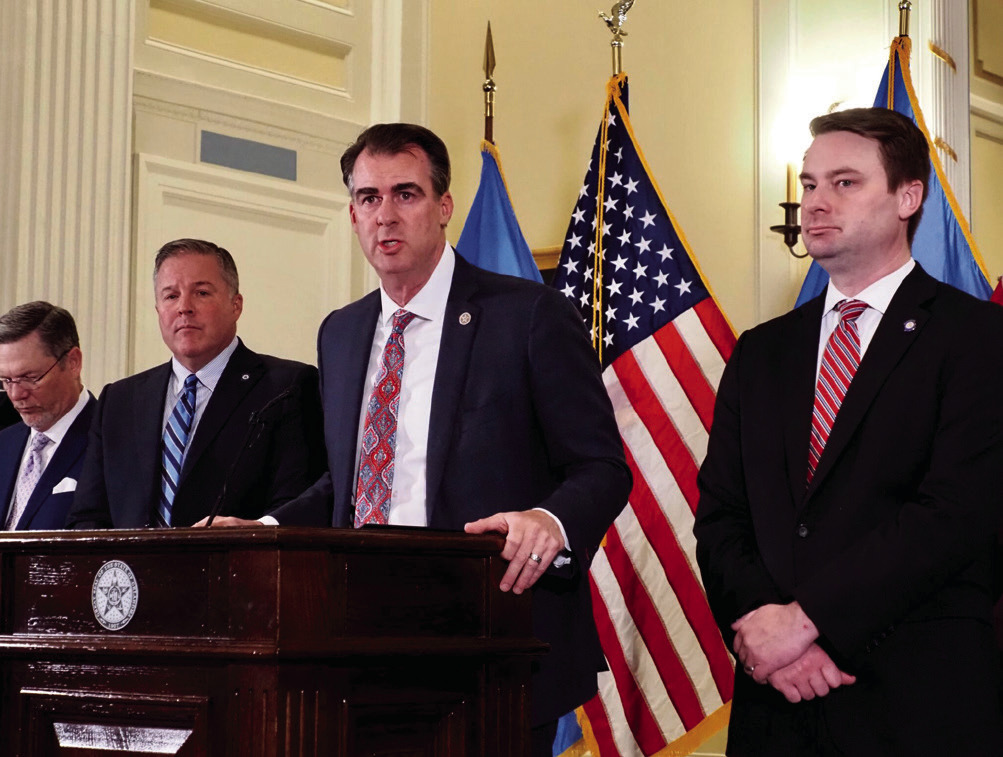
Gov. Kevin Stitt initially called for removing the spending limit on the tax credit program. But on Wednesday, he celebrated the budget deal as a way to “continue to fund education at record levels while promoting education freedom in our state.”
Nuria Martinez-Keel covers education for Oklahoma Voice. She worked in newspapers for six years, more than four of which she spent at The Oklahoman covering education and courts. Nuria is an Oklahoma State University graduate.
Left, Gov. Kevin Stitt speaks at a news conference Wednesday with legislative leaders to announce details of the Fiscal Year 2027 state budget at the state Capitol in Oklahoma City. (Photo by Nuria Martinez-Keel/Oklahoma Voice)