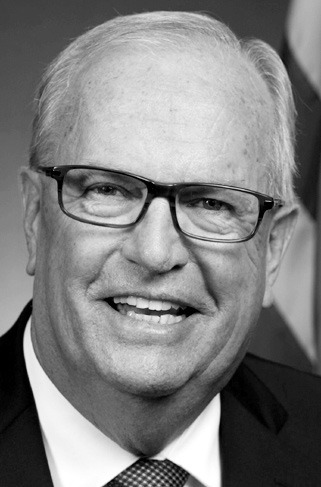
Williams Wants Legislation to Aid Prison Drug Searches
Rep. Danny Williams, R-Seminole, is currently working toward requesting legislation that would create a new investigative unit under the Oklahoma Bureau of Narcotics and Dangerous Drugs (OBNDD) that would be able to go into any state came after a recent interim study Williams held to determine the effect of illegal immigration on Oklahoma corrections’ system and on law enforcement. The study was held before the House Corrections and Criminal Justice Committee.
“This study revealed that we have a massive problem of illegal drugs in Oklahoma prisons and with cartel members running drug operations from prison that imperil the public at large,” Williams said. “This legislation will help us curb this threat.
Williams began his study with information from Oklahoma’s attorney general about a quadruple homicide from August 2022 that involved Chinese nationals who operated a marijuana farm in Kingfisher County. Three men were shot execution style by shotguns held to the backs of their heads. A woman was shot in the abdomen. Another man sustained a gunshot wound but survived after being Medi-flighted for emergency surgery. It took personnel from six law enforcement agencies to process the gruesome scene. Williams also told about law enforcement encountering women who could speak no English and who appeared to live only on a mattress on a floor strewn with condoms and other reminders that they were victims of sex trafficking.
Since medical marijuana was legalized by state voters in 2018, criminals from China, Mexico, Cuba, Russia and other countries have worked together to take over much of the industry in Oklahoma, law enforcement report. These criminals have no respect for laws or public safety, Williams said, and they are not content with only growing black-market marijuana. They also produce and distribute fentanyl, and they engage in sex and labor trafficking.
“It should be no surprise to this committee that many of these criminals are foreign nationals who have entered our country nationals who continue to perpetrate criminal activities and endanger our people.”
Williams said many foreign nationals are able to operate illegally primarily through straw purchases of medical marijuana licenses, in which they recruit a front-man to lease real estate or to purchase the license but let the foreign national operate the business.
He said foreign nationals are creating costs that cannot be quantified for the state. An example is the Oklahoma Department of Corrections reporting it currently houses as many as 500 illegal immigrants convicted of state crimes at an average cost of $63.53 per inmate per day. The state pays roughly $11 million per year to incarcerate illegal immigrants, he said. The state also bears the burden of the education, health and welfare of as many as 100,000 illegal immigrants, at an estimated cost of $750 million per year, he said.
That’s in addition to the toll on human life. In 2017, Oklahoma recorded 54 fentanyl overdoses, he said. Five years later, that number grew to 474.
“We are part of a policy- making group to establish quality of life in Oklahoma,” Williams said. “These statistics and these conditions are horrible and deplorable and unacceptable. And I think we must do something about it in the near term to protect people from those who have no regard for human life.”
Williams gave kudos to the leadership of Donnie Anderson, director of the Oklahoma Department of Narcotics and Dangerous Drugs, saying the agency has confiscated countless tons of illegal and dangerous drugs and arrested untold numbers of traffickers.
Anderson presented at the study, highlighting the link between cartel activity, drug trafficking, and community harm in Oklahoma. He emphasized the exponential rise in synthetic opioid trafficking, particularly fentanyl, which continues to devastate communities. He also noted that while drug enforcement is critical, the high addiction rates in Oklahoma underscore the need for simultaneous investments in treatment facilities. He called attention to the limitations imposed by current resources and requested legislative support for a more comprehensive drug intervention strategy.
“If we don’t address the addiction crisis alongside enforcement, we’ll never reach the end of this epidemic,” Anderson said. “We must break the cycle of supply and demand.”
Anderson also spoke to the need to address illegal immigrants who he said are running transnational criminal organizations from within our prisons.
“Without more resources, we’re fighting a losing battle against drug smuggling and cartel influence,” he said.
His recommendations include strengthening penalties for synthetic drug distribution through legislation; increasing state funding for addiction treatment centers, focusing on accessibility in rural and underserved areas to help mitigate demand; and enhancing inter-agency collaboration such as supporting programs that allow local law enforcement to work with federal agencies to identify, apprehend, and prosecute cartel affiliates operating within Oklahoma’s borders.
Shari Rendall, director of state and local engagement with the Federation for American Immigration Reform (FAIR) also addressed study participants.
She presented on the impact of illegal immigration on U.S. communities, emphasizing that issues originating at the border, such as gang infiltration and criminal activity, ultimately spread nationwide. She provided statistics indicating that individuals on terrorist watch lists, along with known gang affiliates, are entering the country illegally. Rendall also highlighted the increase in the number of people entering the country and noted that while border security once prevented many of these threats, recent federal policy shifts have led to new challenges.
Her recommendations included establishing a multi-state compact to determine common practices for managing and processing illegal immigrants and to support law enforcement collaboration across state lines; advocating for federal reforms for stricter immigration policies; and developing a state-level 287(g) program to allow more local law enforcement officers to perform limited immigration enforcement functions, especially in areas with high illegal immigration rates.
Tulsa County Sheriff Vic Regalado and Sheriff Mark Lamb from Pima County, Arizona, also shared perspectives from law enforcement and made recommendations during the study.
Williams said he’s hopeful the change of the presidential administration in January will stop illegal immigrants from crossing the southern border, which in turn will help Oklahoma.